
Reader-supported: some links are partner links; we may earn a commission at no extra cost to you, and it never affects our verdict. See our disclosure.
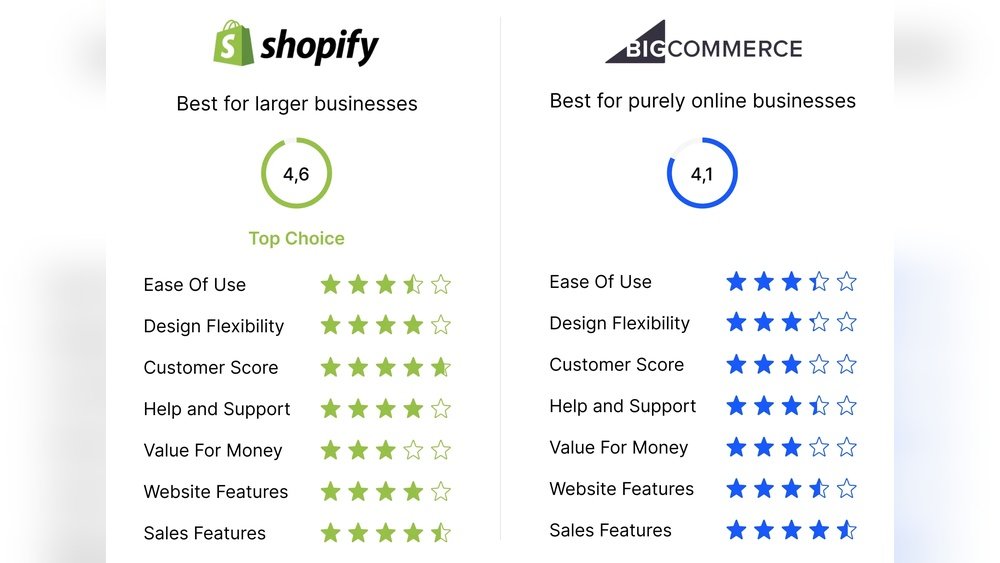
Quick verdict: Shopify (from $39/mo) wins on ease of use and the largest app ecosystem, but charges extra transaction fees unless you use Shopify Payments. BigCommerce ($29 Standard / $79 Plus / $299 Pro) stands out for zero transaction fees on every plan and more built-in features — great if you want fewer paid apps. Choose Shopify for ecosystem and simplicity, BigCommerce to avoid fees.
Compared at a glance (2026)
| Shopify | BigCommerce | |
|---|---|---|
| Entry price | $39/mo | $29/mo (Standard) |
| Transaction fees | Yes, unless Shopify Payments | None, on any plan |
| Apps | Largest ecosystem (often needed) | More built-in features |
| Best for | Ease + app ecosystem | No fees + built-in features |
Pricing verified against 2026 sources incl. Jetfuel Agency. Confirm current prices on each vendor’s site.
How we review: total real cost (subscription + apps/hosting + fees), ease of use, scalability, and real user feedback — see our methodology. Last updated July 2026.
Shopify and BigCommerce are the two leading hosted e-commerce platforms — both handle hosting, security, and payments so you can focus on selling. The real difference comes down to two things: how much you lean on apps, and how you feel about transaction fees. Here is how they compare where it matters.
Pricing and the transaction-fee question
Entry pricing is close — Shopify starts at $39/mo, BigCommerce at $29/mo (Standard), scaling to $79 Plus and $299 Pro. The difference that adds up is fees. Shopify charges an extra transaction fee (roughly 2% on the Basic plan) on every sale unless you use Shopify Payments; BigCommerce charges no transaction fees on any plan, whichever gateway you use. If you want to keep your existing payment processor, BigCommerce quietly saves you money on every order.
Watch BigCommerce’s one catch: each plan has an annual online-sales threshold, and crossing it bumps you to the next tier. For a high-volume store that is worth modeling before you commit.
Ease of use and design
Shopify is the easier platform to start and run. Setup is guided, the admin is clean, and its theme store and page builders are polished. BigCommerce is capable but shows more settings up front, which gives you control at the cost of a steeper first hour. For a non-technical owner who wants a store live this weekend, Shopify wins on smoothness.
Features: apps vs built-in
This is the core trade-off. Shopify keeps its core lean and relies on the largest app ecosystem in e-commerce — almost anything is possible, but advanced features often mean paid monthly apps that stack up. BigCommerce builds more in natively (multi-currency, faceted search, gift cards, no-code promotions), so you add fewer apps, though its smaller marketplace means the perfect niche app sometimes does not exist. Shopify if you want maximum flexibility via add-ons; BigCommerce if you would rather it come in the box.
SEO, multichannel, and scale
Both are strong on SEO and sell across channels (Amazon, eBay, Instagram, Facebook). BigCommerce gives slightly more control over URLs and metadata and includes built-in schema; Shopify counters with a faster path to social and marketplace selling through apps. Both scale to large catalogs and high volume, so channel and SEO differences are marginal for most stores.
Frequently asked questions
Does BigCommerce really have no transaction fees?
Yes. BigCommerce charges no added transaction fee on any plan, regardless of which payment gateway you use. Shopify only waives its extra transaction fee if you use Shopify Payments; with a third-party gateway it adds a per-sale fee.
How much does Shopify take from a $100 sale?
With Shopify Payments on the Basic plan, roughly 2.9% + 30¢ — about $3.20 on a $100 card sale. Using a third-party gateway adds Shopify’s extra transaction fee on top of your processor’s rate.
Which is easier for a beginner?
Shopify. Its guided setup, cleaner admin, and larger template/app ecosystem make it the smoother platform for a first-time store owner. BigCommerce is powerful but exposes more settings early on.
Should I switch from BigCommerce to Shopify?
Only if you need Shopify’s specific apps or ecosystem and are fine using Shopify Payments to avoid transaction fees. If you value zero transaction fees and built-in features, BigCommerce may already be the better fit — see our migration guide before you move.
The bottom line
Choose Shopify if you want the easiest setup and the biggest app ecosystem, and you are happy to use Shopify Payments. Choose BigCommerce if you want zero transaction fees, more features built in, and freedom to keep your own payment gateway. Start a free trial on both, load a few real products, and see which admin you would rather live in.
See Shopify → See BigCommerce →