
Reader-supported: some links are partner links; we may earn a commission at no extra cost to you, and it never affects our findings. See our disclosure.
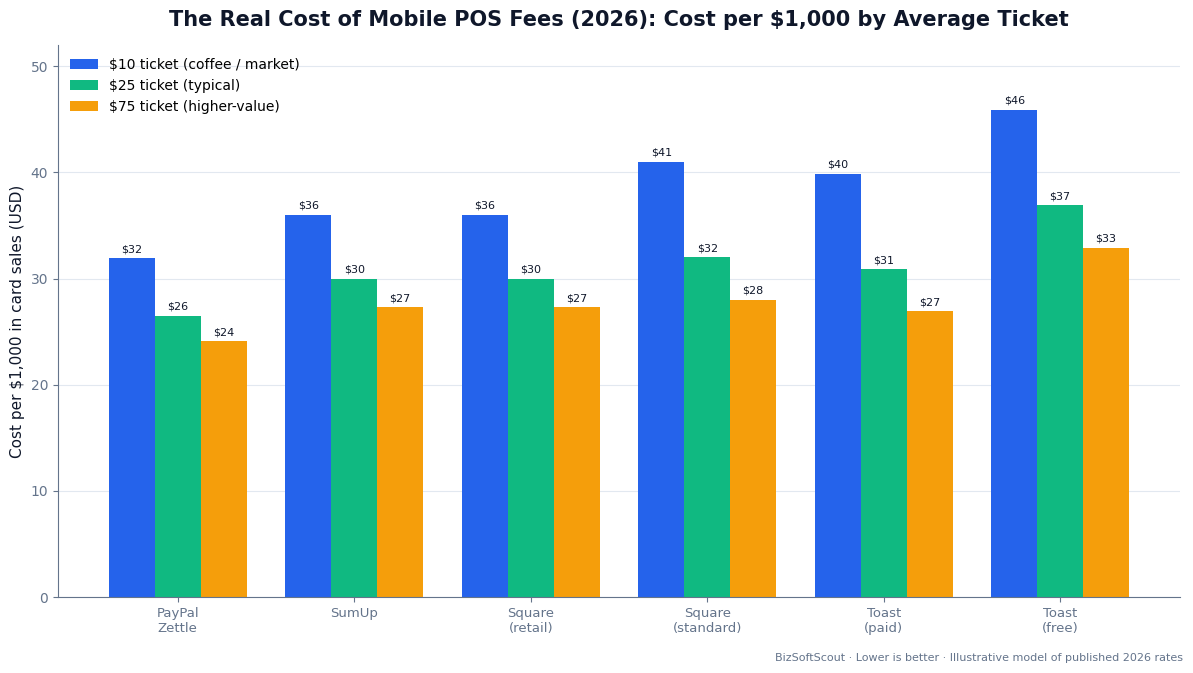
Quick verdict: The cheapest mobile POS depends on your average ticket size, not the advertised rate. Because every card system adds a fixed per-transaction fee (9¢–30¢) on top of its percentage, a seller with a $10 average ticket pays a far higher effective rate than one with a $75 ticket — on the exact same provider. Across the systems we modeled, effective cost ranged from about 2.4% to 4.6% per $1,000 in card sales. PayPal Zettle (2.29% + 9¢) was cheapest at every ticket size we tested; Toast’s free tier (3.09% + 15¢) was the most expensive.
How we did this: we modeled published 2026 card-present rates across three average ticket sizes. Figures are illustrative — confirm current rates with each provider. See our methodology. Last updated July 2026.
Every card reader advertises one number — “2.6%” — and that number quietly lies to small-ticket sellers. The reason is the fixed per-transaction fee tacked on to the percentage. On a $100 sale, a 15¢ fee is a rounding error. On a $4 latte, it is another 3.75% on top of the headline rate. So a coffee cart and a furniture store using the identical POS pay wildly different effective rates. We ran the math to show exactly how much.
Effective cost per $1,000 in card sales
Each cell shows the total processing cost on $1,000 of card sales at that average ticket size, with the effective rate in parentheses. Lower is better.
| Provider (card-present rate) | $10 ticket (coffee / market) |
$25 ticket (typical) |
$75 ticket (higher-value) |
|---|---|---|---|
| PayPal Zettle — 2.29% + 9¢ | $31.90 (3.19%) | $26.50 (2.65%) | $24.10 (2.41%) |
| SumUp — 2.6% + 10¢ | $36.00 (3.60%) | $30.00 (3.00%) | $27.30 (2.73%) |
| Square (retail) — 2.6% + 10¢ | $36.00 (3.60%) | $30.00 (3.00%) | $27.30 (2.73%) |
| Square (standard) — 2.6% + 15¢ | $41.00 (4.10%) | $32.00 (3.20%) | $28.00 (2.80%) |
| Toast (paid) — 2.49% + 15¢ | $39.90 (3.99%) | $30.90 (3.09%) | $26.90 (2.69%) |
| Toast (free tier) — 3.09% + 15¢ | $45.90 (4.59%) | $36.90 (3.69%) | $32.90 (3.29%) |
Interchange-plus processors like Helcim are not in this table because their rate is not fixed — it falls as volume rises, which is exactly why they win for higher-volume sellers. Rates cross-checked against 2026 roundups from TechnologyAdvice and Fit Small Business.
Three findings that change how you should choose
1. The fixed fee is a hidden tax on small tickets
At a $10 average ticket, the per-transaction cents fee inflates Square’s standard effective rate from 2.6% to 4.1% — a 58% jump over the sticker number. Coffee shops, food trucks, and farmers-market vendors feel this hardest because they run many tiny transactions. If that is you, our best mobile POS for farmers markets and best POS for coffee shops guides weigh this directly.
2. Ticket size, not brand, is the biggest lever
The same provider swings roughly 1.3 percentage points in effective cost between a $10 and a $75 ticket. That difference dwarfs the 0.1–0.3% gap between competing brands. Pick the right category of pricing for your ticket size first; obsess over brand-to-brand rate differences second.
3. “Free” POS software can be the most expensive
Toast’s free tier carried the highest processing rate in our set, so at real volume it can cost more per year than a paid plan with a lower rate — the classic free-plan trap. We break down where that line sits in Toast vs Square for restaurants and Square Appointments fees explained.
How we calculated this
We took each provider’s published 2026 card-present rate (percentage plus fixed per-transaction fee) and modeled the total cost of processing $1,000 in card sales at three average ticket sizes: $10, $25, and $75. The number of transactions per $1,000 equals $1,000 divided by the ticket size. Effective cost equals (rate × $1,000) + (fixed fee × number of transactions). Rates were taken from each provider’s pricing page and cross-checked with the industry sources linked above in July 2026. Figures are illustrative model outputs, not quotes — confirm current pricing before deciding.
Frequently asked questions
What is the cheapest mobile POS in 2026?
It depends on your average ticket. In our model, PayPal Zettle (2.29% + 9¢) was the cheapest at every ticket size tested. But the effective-rate gap between providers shrinks as your ticket size grows, so a low-ticket seller should weight the fixed fee heavily while a high-ticket seller can focus more on the percentage and on features.
Why is my effective card rate higher than the advertised rate?
Because of the fixed per-transaction fee. A rate like “2.6% + 15¢” adds 15 cents to every sale regardless of size. On small tickets those cents represent a large share of the sale, pushing your true effective rate well above the headline percentage.
Is free POS software actually free?
The software can be free, but you still pay card processing on every sale — and free tiers often carry a higher processing rate. At real volume, a “free” plan with a higher rate can cost more per year than a paid plan with a lower one. Always model your actual card volume.
Which POS is cheapest for a coffee shop or low average ticket?
Low-ticket sellers should prioritize the smallest fixed per-transaction fee. In our model, PayPal Zettle’s 9¢ fee made it cheapest at a $10 ticket; SumUp’s 10¢ was next. Square’s standard 15¢ fee costs low-ticket sellers the most among the flat-rate options.
The bottom line
Do not choose a mobile POS on its advertised percentage alone. Estimate your average ticket, count how many transactions make up $1,000 of sales, and add the fixed fee in — that is your real rate. For most low-ticket sellers the smallest per-transaction fee wins; for higher-volume, higher-ticket businesses, an interchange-plus processor often beats every flat rate here.
Related Guides
- Best Mobile POS for Farmers Markets
- Best POS for Coffee Shops
- Toast vs Square for Restaurants
- Square Appointments Fees Explained
- Best POS for Liquor Stores